
For most financial professionals, life settlements aren’t something they deal with every day. A client may have an opportunity once every few years, and when that happens, questions can come quickly. Does the policy qualify? How does the market work? Who are the buyers? What regulations apply? And ultimately, what might the policy actually be worth?
At SFS Life Settlements, those are the questions we deal with every day.
Our job is to know the life settlement market, understand where the opportunities are and help brokers and advisors navigate a marketplace they shouldn’t have to become experts in themselves. That means understanding the regulatory environment, maintaining relationships across the institutional buyer market, knowing how different buyers evaluate policies and, most importantly, creating competition to help maximize value for the policy owner.
The latest data from the European Life Settlement Association (ELSA) provides an interesting look at the marketplace behind that work and reinforces why having the right life settlement resource matters.
According to ELSA’s newly released Life Settlement Licence Matrix 2026, life settlement providers collectively hold 685 licenses across the United States. There are currently 30 providers licensed in one or more U.S. states or territories, with 19 holding licenses in 20 states or more.
While the total number of licenses declined 3.5% from 2025, ELSA makes an important point: that shouldn’t necessarily be viewed as a negative signal for the secondary market. In fact, ELSA reports that the market grew 10% in 2025 compared with the previous year and notes that more of the policies being transacted are being held by institutional life settlement providers.
That’s the bigger story.
A Growing Market Creates More Opportunity, But It Also Requires Expertise
As the life settlement market has evolved, it has become an increasingly established part of the financial landscape.
For brokers and advisors, that’s good news. It means there is an active secondary market where a life insurance policy that a client no longer needs, wants or can afford may have value beyond its cash surrender value.
But having a market and knowing how to navigate that market are two different things.
Different institutional buyers can have different investment criteria, portfolio needs and appetites for particular policies. Regulatory and licensing requirements can vary from state to state. Underwriting matters. Policy structure matters. The insured’s age and health matter. Even market conditions and the current needs of individual buyers can affect how a policy is viewed.
That’s why SFS has spent years building the knowledge, relationships and processes necessary to navigate the market on behalf of brokers, advisors and their clients.
We don’t expect our referral partners to know which institutional buyer may be interested in a particular policy. We don’t expect them to understand the regulatory requirements of every state or spend their time trying to create a competitive marketplace for one client’s policy.
The advisor’s role is to recognize when there may be an opportunity worth exploring. SFS can provide the specialized expertise needed to determine what that opportunity might look like.
The Map Tells an Important Part of the Story
The regulatory map included in ELSA’s report is particularly helpful because it visually demonstrates just how established the secondary life settlement market has become across the country.
Today, 43 U.S. states and Puerto Rico have a regulated secondary market for life settlements. These regulations provide oversight around areas such as licensing, transaction procedures, disclosures and policyholder protections.
Five states, Alabama, Missouri, South Carolina, South Dakota and Wyoming, along with the District of Columbia, do not have specific life settlement regulatory measures. ELSA points out that this does not necessarily mean life settlements are unregulated in those jurisdictions. Other insurance or securities regulations may still apply, and transactions continue to occur.
Michigan and New Mexico specifically regulate viatical settlements involving terminally or chronically ill insureds rather than explicitly regulating the broader life settlement market.
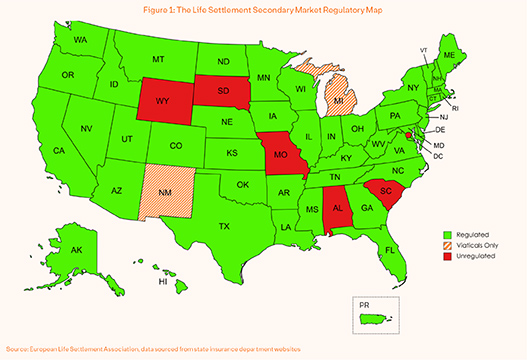
When you look at the map, what stands out isn’t simply the number of regulated states. It’s the reach and maturity of the marketplace.
For an advisor looking at a single client’s policy, however, that national marketplace can also be difficult to navigate. Knowing that a market exists doesn’t tell you which buyers should see a policy, how the policy should be positioned or whether an offer represents the best opportunity available.
This is where having an experienced resource becomes valuable. SFS works within this marketplace every day, helping advisors understand the opportunity while managing the complexities of the life settlement process on behalf of their clients.
The Provider and Broker Play Very Different Roles
One of the most important distinctions in the ELSA report is the difference between a life settlement provider and a life settlement broker.
A provider is on the purchasing side of the transaction and may purchase policies for its own portfolio or represent investors and other investment vehicles.
A life settlement broker plays a different role. The broker represents the policy owner in the sale of the policy and can solicit multiple competitive bids on the owner’s behalf. ELSA also notes that, under insurance regulations in most states, brokers owe a fiduciary duty to the policy owner to act according to their instructions and in their best interests.
That distinction is central to the way SFS approaches the market.
We sit on the policy owner’s side of the table. When an advisor brings us a potential case, our objective isn’t simply to find a buyer willing to make an offer. We want to understand what the broader marketplace may be willing to pay for that policy.
That means knowing the market, knowing the buyers and creating competition whenever appropriate.
Why Competition Matters
SFS works with all licensed Providers, giving an appropriate policy the opportunity to be evaluated by buyers with different investment objectives and portfolio needs.
Not every buyer values every policy the same way. A policy that doesn’t fit one buyer’s portfolio may be attractive to another. Buyers can have different underwriting approaches, investment objectives and needs at different points in time.
That’s why we believe there is an important difference between getting an offer and taking a policy to market.
Think about how you would approach almost any other significant financial asset. If you were selling a business, a piece of real estate or another valuable asset, you probably wouldn’t assume the first interested buyer had established its maximum value. You would want exposure to the marketplace because competition helps establish what the asset may actually be worth.
A life insurance policy deserves the same consideration.
When a client has paid premiums into a policy for years or even decades, surrendering it to the insurance carrier or allowing it to lapse can be an irreversible decision. Before that happens, it can be worthwhile to determine whether a secondary-market opportunity exists.
There is never a guarantee that a policy will qualify for a life settlement or that multiple buyers will bid on it. But when a policy may represent a meaningful financial asset, we believe it deserves to be properly evaluated before the client walks away from it.
A Resource for Advisors and Brokers
For most financial advisors and insurance professionals, life settlements will never be something they encounter every day, nor should they need to become experts in the market. What matters is recognizing the situations where a life settlement may be worth exploring.
A client may be considering surrendering a policy because premiums have become difficult to justify. Their estate-planning needs may have changed, coverage that once served an important purpose may no longer be necessary, or access to liquidity may have become a greater priority. Each situation is different, and none automatically means a life settlement is the right answer.
This is where SFS can become an extension of the advisor’s team. We can evaluate the policy, help determine whether a secondary-market opportunity exists and, when it does, navigate the marketplace on the client’s behalf. The advisor remains at the center of the relationship while SFS brings the specialized market knowledge, buyer relationships and experience needed to explore the opportunity.
The goal isn’t to make every policy a life settlement. It’s to make sure an appropriate client understands all of the options available before making an irreversible decision about an asset they may have owned and funded for many years.
Knowing What’s Possible Can Change the Conversation
One of the reasons we spend so much time educating advisors about life settlements is that a client’s circumstances can change dramatically over the life of an insurance policy.
Estate-planning needs change. Businesses are sold. Beneficiaries become financially independent. Premiums become burdensome. Health changes. Retirement priorities shift. Sometimes liquidity becomes more valuable to the client today than maintaining a death benefit they originally purchased years or even decades earlier.
When that happens, the conversation shouldn’t automatically begin and end with the policy’s cash surrender value.
There may be another market for the asset.
And as the ELSA data demonstrates, that market is substantial. Hundreds of provider licenses exist across the country, most states have specific regulatory frameworks governing life settlement transactions, and institutional participants continue to operate in a secondary market that ELSA reports grew 10% last year.
For advisors and brokers, the opportunity isn’t about learning the intricacies of that marketplace themselves. It’s about knowing the marketplace exists and having a trusted resource who knows how to access it.
The Market Is Growing. So Is the Opportunity to Help Clients.
The latest ELSA data gives us another useful snapshot of an industry that continues to evolve.
There are 30 providers licensed in one or more states or territories. Nineteen hold licenses in at least 20 states. Forty-three states and Puerto Rico have regulated secondary markets. And despite a reduction in the overall number of provider licenses, ELSA reports that the secondary market itself grew 10% in 2025.
For SFS, those aren’t simply industry statistics. They represent the marketplace we navigate every day on behalf of our partners and their clients.
As the market grows and institutional participation continues to evolve, our role is to stay on top of those changes so our partners don’t have to. We want brokers and advisors to know that when a client’s life insurance circumstances change, there is a resource they can turn to for an informed look at what options may be available.
Not every policy will become a life settlement. But every appropriate policy deserves to have its options explored before an irreversible decision is made.
If you have a client with a policy they no longer need, want or can afford, or you’re simply wondering whether a life settlement might make sense, SFS Life Settlements would be happy to help you explore the opportunity.
We know the market, we know the buyers, and we can help you understand what’s possible.
Source: European Life Settlement Association, Life Settlement Licence Matrix 2026 and Secondary Market Regulation Fact Sheet.