
When a client receives an offer for their life insurance policy, it’s natural to assume that number represents what the policy is worth.
But an offer and market value are two very different things.
An offer tells you what one buyer is willing to pay for a policy at a particular moment. It doesn’t tell you what another buyer might pay, how that policy fits within another buyer’s portfolio, or what could happen if multiple buyers were given the opportunity to compete for it.
That distinction is one of the most important things financial advisors, insurance professionals and other trusted advisors should understand about the life settlement market.
At SFS Life Settlements, we work with 20+ potential buyers because we believe the best way to determine the market value of a policy is to create a market around it. Different institutional buyers can evaluate the same policy differently based on their portfolio needs, underwriting and return requirements. The goal is to identify where the greatest interest exists and use that competition to help produce the strongest possible outcome for the policy owner.
And sometimes, the difference can be significant.
Representation Matters
We recently put together three examples that illustrate just how much the outcome can change when a policy is exposed to the broader market.
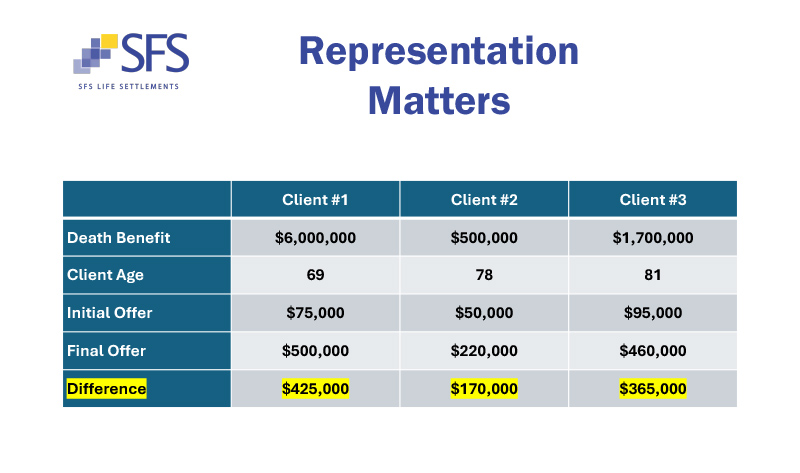
Suggested caption: Three examples showing the difference between an initial life settlement offer and the final offer achieved after market representation and competition.
In the first example, a 69-year-old policy owner had a $6 million death benefit and received an initial offer of $75,000. The final offer was $500,000.
That’s a difference of $425,000.
In the second example, a 78-year-old with a $500,000 policy received an initial offer of $50,000. The final offer reached $220,000, an increase of $170,000.
In the third example, an 81-year-old with a $1.7 million policy received an initial offer of $95,000. The final offer was $460,000.
That’s another $365,000 in value.
These examples reinforce something we talk about frequently at SFS:
One offer isn’t a market.
Why Can Offers Be So Different?
It can be tempting to think of life insurance policies as having a relatively fixed market value. In reality, the life settlement market doesn’t work that way.
Institutional buyers are evaluating policies based on their own criteria. They may have different portfolio needs, different underwriting approaches and different return requirements. The characteristics that make a policy attractive to one buyer may be less attractive to another, and those differences can affect what each is willing to pay.
That means the first offer a policy owner receives may be a legitimate offer, but it does not necessarily establish what the broader market is willing to pay.
This is where representation becomes so important.
When SFS represents a policy owner, our role isn’t simply to find someone willing to purchase the policy. We work to create competition for it. By presenting the opportunity to 20+ potential buyers and negotiating among those that have interest, we can help determine where the market places the greatest value on that particular policy.
The numbers in the examples above demonstrate why that process matters.
The Risk of Stopping at the First Offer
For financial professionals, there’s a larger issue here than simply getting a better price.
Clients rely on their advisors to help them understand their options before making significant financial decisions. If a client is considering selling a life insurance policy, surrendering it to the carrier or allowing it to lapse, the question shouldn’t simply be, “Do we have an offer?”
The better question is, “Have we adequately tested the market?”
If the answer is no, there may still be substantial value left unexplored.
Imagine the first client in our examples accepting the initial $75,000 offer without further market exposure. That client would never have known another outcome was possible. The same is true of the client whose $50,000 initial offer eventually became $220,000 or the client whose $95,000 offer ultimately reached $460,000.
Those differences can have a meaningful impact on a client’s financial picture.
And for the advisor, taking the extra step to explore the broader market can reinforce the value of the relationship. You’re helping the client make a decision with more information rather than simply accepting the first option presented.
You Don’t Have to Become a Life Settlement Expert
One of the messages we continually share with our broker and advisor partners is that you don’t need to become an expert in the life settlement market.
That’s our job.
You simply need to recognize the situations where a life settlement may be worth exploring.
Perhaps a client is considering surrendering a policy because the premiums have become difficult to justify. Maybe the original reason for purchasing the coverage has changed. An estate plan may have evolved, a business may have been sold, or a client may need additional liquidity.
Whatever the circumstances, a life insurance policy can represent an asset with value beyond its cash surrender value.
Before that asset is surrendered, allowed to lapse or sold based on a single offer, it makes sense to understand what the broader market may be willing to pay.
SFS can step in at that point and manage the process while allowing you to remain focused on your client relationship.
Knowing the Market Is Part of the Value
The life settlement market continues to evolve, and knowing where buyer interest exists is an important part of achieving a strong outcome.
That’s why SFS has built relationships across a broad network of institutional buyers. We understand that no single buyer represents the entire market, and we don’t believe a policy owner should have to rely on one buyer’s opinion of what their policy is worth.
Our job is to represent the policy owner, expose the policy to competition and negotiate among interested buyers.
Sometimes that competition produces incremental improvement.
Other times, as the examples above demonstrate, the difference can be hundreds of thousands of dollars.
For the financial professionals we work with, that’s really the opportunity. You don’t need to know which buyer may value a particular policy most highly. You don’t need to navigate the institutional market yourself. You just need to know that there may be more value available and have a resource you trust to find out.
Before Your Client Accepts an Offer, Ask One More Question
If your client already has an offer for their life insurance policy, that doesn’t necessarily mean the process is finished.
It may simply mean you now have a starting point.
Before accepting it, ask whether the policy has truly been exposed to the market. Has there been meaningful competition? Have multiple institutional buyers had the opportunity to evaluate it? Has someone represented the policy owner throughout that process?
Because as these three examples demonstrate, the difference between an offer and a competitive market can be substantial.
At SFS Life Settlements, we work with financial advisors, insurance professionals and other trusted advisors to help their clients understand what may be possible before making a final decision about a policy.
If you have a client considering selling, surrendering or walking away from a life insurance policy, reach out to SFS Life Settlements. We’d love the opportunity to take a look, explore the market and help you determine what the policy may really be worth.
Because one offer isn’t a market.